
Written by Lori Bumbaco, MS, RDN, CSO, LDN, Oncology Dietitian
The fruits and vegetables options at the supermarket are not always in sync with the seasons. You might have noticed that we can enjoy produce like tomatoes, zucchini, or watermelon no matter what time of the year it is.
While that is not necessarily a bad thing, it may cause us to forget how eating with the seasons provides unique opportunities to build delicious and nutritious choices into our diet.
A matter of taste
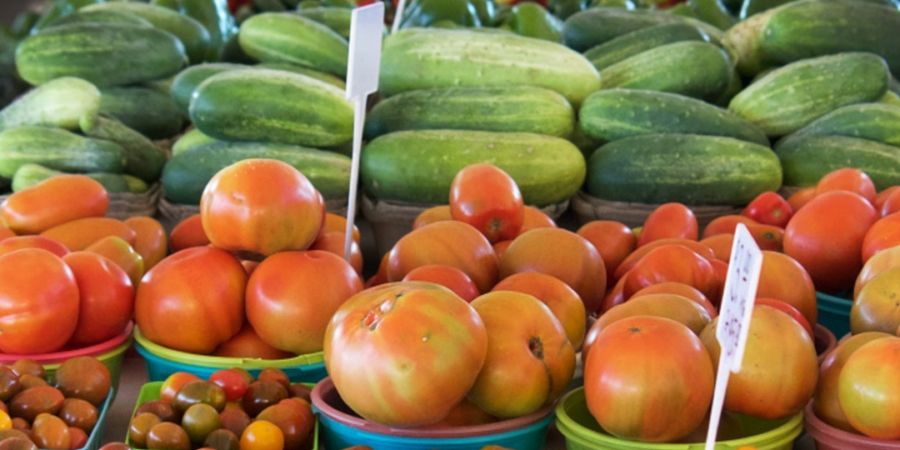
Let’s get right to the point. Seasonal produce is far superior in flavor. If you ever ate an heirloom tomato in August, you know exactly what we mean. There is simply no comparison to the lackluster tomatoes available from the grocery store in the dead of winter. Tomatoes that are harvested in the summer are rich, sweet, and juicy. Those grown out-of-season tend to be grown in greenhouses or are imported. The result is a bland and watery tomato because it was picked before fully ripening.
Tomatoes are just one example of the significant difference in flavor we get from seasonal produce.
A feast for the eyes
Do you agree that you can tell if a fruit or vegetable is in season or not just by looking at it? A good example are strawberries. When you bite into a strawberry that was harvested locally, notice how the beautifully bright red color saturates the inside of the berry. Eating a strawberry during the winter almost always guarantees a white color inside. That color indicates freshness, which will correspond not only to a sweeter flavor, but also to a higher concentration of antioxidants.
A nutritional edge
Eating seasonal, local produce guarantees the highest amount of nutrients. Once a fruit or vegetable is picked, the nutrients inside will start to decline. The longer the time spent traveling to our plate, the greater the loss of nutrients, including vitamins and antioxidants.
It is important to point out that frozen produce are nutritionally equivalent with those that are fresh and in season. Food producers actually flash-freeze those almost immediately after they’re harvested, so it is preserving a lot of those nutrients.
Seasonal eating also offers some indirect nutritional advantages. If your diet shifts with the season, it ensures that you’re eating a wider range of those fruits and vegetables – which in turn means that you’re getting a wider variety of nutrients.
Matters of money and access
For the most part, seasonal foods can be cheaper, thanks to the laws of supply and demand: If a food is in season, suppliers will have more of it and prices should be lower. Whereas if it’s a food not in season, you have less of it and must transport it from far away. This means that we must pay for those transport fees, the refrigeration fees, all those things that really add up and can make the out-of-season foods more expensive.
Some supermarkets have contracts that keep prices consistent year-round, but at a locally owned farmer’s market, we’re going to save more money shopping in season.
Availability of seasonal foods is influenced by many factors, however access to them is not equal. An innovative approaches can address that problem.
Some areas, for instance, take part in community-supported agriculture programs to connect consumers directly with local farmers. Mobile markets that operate from trucks, vans or buses can reach neighborhoods with few grocery stores. Did you know that Cancer Wellness Center is a designated drop off point for Prairie Wind Family Farm? You can learn more by visiting here.
How to tell what’s in season
The Seasonal Food Guide, an app and website supported by the GRACE Communications Foundation draws on data from several sources to offer a state-by-state look at what’s in season. Check out their website here. Visiting a local farmers market can show you what’s in season and pay off in other ways. Talking to the local farmers can really come in handy, because they’ll know exactly what’s growing at that specific time. We can be introduced to something that we haven’t tried before, and changes are it will be absolutely delicious.
They’re important in any form
In season or out, fresh or frozen, fruits and vegetables are part of a healthy eating pattern.
Fruits and vegetables are going to be some of the most nutrient-dense foods that we have in our diet. Experts recommend adults eat 1.5 to 2 cups of fruit each day and 3 to 4 cups of vegetables. A diet rich in plant-based foods can lower the risk for many chronic diseases.
If seasonal eating is not an option for you, making sure that you’re eating those fruits and vegetables regardless is the most important thing.
Local farmers markets can help us discover tasty new varieties of fruits and veggies. Looking forward to a special time of year when the variety of options are available to help deliver the optimal nutrition for our diet.